UT Researchers Target Diabetes
Compound has potential to be "billion-dollar drug"
2011 The Memphis Business Journal
By Michael Sheffield
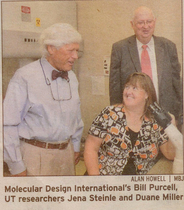
A new compound being developed at the University of Tennessee Health Science Center could be the link to preventing blindness in diabetic retinothropy patients. It has already received $1 million in research grants from the Juvenile Diabetes Research Foundation and the National Institutes of Health. Following the lengthy process of clinical trials and approval, the research could lead to "billion-dollar drug." The compound currently known as 49b, was developed by Jena Steinle, associate professor at UTHSC, and Duane Miller, chair and professor of the department of pharmaceutical services at the UT College of Pharmacy.
Steinle's research allowed her to duplicate diabetic conditions in animals without making the animals diabetic, a process that would have taken years to accomplish. In the Type I diabetes model, 90 percent of people with the disease go blind because the glucose kills the nerves," Steinle says. "If we fix the nerves, we may not have these problems." Steinle and Miller have connected with Molecular Design International, a company that helps shepherd compounds such as 49b to market. Steinle has developed an eye drop that is taken once a day by patients. In lab animals, the treatment is shown to prevent diabetic retinothopy. So far, Steinle's work has resulted in a $1 million grant from the Juvenile Diabetes Research Foundation and $100,000 from NIH. Steinle is preparing to apply for a $2 million grant from NIH in December that would allow 49b to be further developed and tested on humans. Steinle, who began working on the compound five years ago when she was at Southern illinois University-Carbondale, says she came to UT's Hamilton Eye Institute to continue development at a facility more dedicated to eye research. The project has received an $80,000 grant from UT, which is being used to help bring the compound into the pharmaceutical market. Molecular Design International has worked with companies suchas Glaxo SmithKline, Merck & Co. Inc. and Eli Lilly and Co. in bridging drugs to the market in the past, and currently has two obesity and oncology drugs in development.
MDI is also working on the development of a wound care product. Bill Purcell, chairman of Molecular Design International, says the drug'sreach could be limitless because of the prevalence of diabetic retinothropyin diabetes patients. "If you have diabetes and you live long enough, you'll probably get diabetic retinothophy, and if you have that, you will go blind,"Purcell, says. "This could stop that, reverse the process of blindness and help people see that wouldn't be able to see. It could be a billion-dollar drug." Miller who has more than 450 patents to his credit, says the process began with 30 drugs that were narrowed down and eventually manipulated as they showed progress. "It'll be a real challenge going from animals to humans, but the only way to really test it is to actually test it in humans," Miller says. "This has high potential." While the process could take up to eight years and "between $50 million and $100 million," Purcell believes the science of 49b is sound enough to move forward, however, moving from the research phase is complex, says Jan Bouton, a partner with Memphis based early stage biotechnology investment company, Innova. Compounds that are designed to prevent a condition rather than cure a disease face challenging trials, she says." They just need to get to the point where it's attractive to someone big enough to pick it up and get the results," Bouton says, "Diabetes is a growing problem and blindness as a result is growing as well. This would be a really good one if they can figure it all out."
|
Market BioNext Wound Product in U.S.
Friday, October 23, 2009
Memphis Business Journal - by Michael Sheffield
Memphis-based Molecular Design International has secured U.S. distribution rights to Bionext's wound protection product, a biocellulose device that creates a physical barrier and helps prevent infection to wounds.
BioNext is a Brazil-based company that manufactures the product and has sold it in five other countries, including China and Italy. The product is gas permeable and impermeable to bacteria. Also, it only needs to be applied once, where other wound care products must be applied multiple times over the duration of the wound, says Bill Purcell, MDI’s founder and chairman. Once the wound is healed, the film can simply be washed away.
BioNext’s biocellulose device can work on stage one and two wounds, which typically include bedsores, diabetic ulcers and first- and second-degree burns. The healing process for burns has been clinically proven to happen in a week with the product. Its limits would be battlefield wounds, which are considered stage three wounds.
Despite that, BioNext’s usefulness in the healing of bedsores is one reason Purcell is exploring the possibility of offering it to the VA Medical Center at Memphis. MDI is working with Huntsville, Tenn.-based S&L Products and Services, a disabled veteran-owned medical equipment and supply distributor.
|
Molecular Design International Receives Research Grant
April 2008
The Daily News
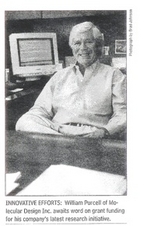
Molecular Design International Inc. of Memphis has received a competing continuation grant $599,008 for pharmacological research. The National Institute of General Medical Sciences, a division of the Department of Health and Human Services, awarded the grant. The funds would permit MDI president and lead scientist, Dr. William Purcell, to continue his current research on the wound-healing properties of a particular chemical compound that he developed, which he calls “9-cis Retinoid Acid Derivative.” The compound has been used effectively to treat common skin conditions such as acne and psoriasis, but also has shown promise in its ability to fight skin cancer. Purcell funded MDI in1975. The company mostly focuses on discovery and out-licensing of new pharmaceutical compounds. MDI has worked on pharmaceutical compounds in the fields of oncology, dermatology, female sexual dysfunction and obesity.
|
Chemist's Thickening Compound Lands $1 Million Federal Grant
March 7, 2005
The Memphis Business Journal article by Scott Shepard
Dermatologists know that a class of drugs called retinoids can promote skin growth and possibly healing. But the also know that retinoids will have their patients climbing the walls from the irritation.
A Memphis scientist thinks he's fixed the problem, and the feds like it so much that they're giving him $1 million to further the idea. A dutch company is so impressed that it has already asked to help commercialize it when the time comes.
"Aging makes the skin extremely thin," says chemist Bill Purcell, a retired UT professor and founder of Molecular Design International. "All retinoids are irritating. You don't want to take an elderly person and slap something on them that turns them red and makes their skin peel." His compound stimulates collagen production and thickens the skin. It may also have applications in wound healing. Phase I results were so promising that the National Institutes of Health awarded the grant under its Small Business Innovation Research Program, which began in 1982 to encourage small business biotech.
Topical retinoids have demonstrated efficacy in the treatment of photo-aging; their use is often limited by their potential to induce irritation," says Alan Moshell, director of the NIH Skin Disease Program. "A non-irritation topical retinoid would be of value in the treatment of aging skin and potentially other conditions such as acne."
In creating his drug, Purcell started with a retinoid used to treat Kaposi's sarcoma, a form of skin cancer often appearing in AIDS patients. "It looked like an exotic molecule, so I said let's use some baling wire and see if we could fix the fence," Purcell says.
He's worked with immunologist James Varani in the Department of Pathology at the University of Michigan to build the molecule and study it. Much of the grant money will fund two more years of animal studies in Varani's lab. Another collaborator is California's Stanford Research Institute, where the drug's toxicology profile will be developed.
Both aspects are needed before Purcell can approach the FDA with an Investigational New Drug application, which allows Phase III human trials.
Both Varani and Stanford have contractual arrangements, but no stake in the drug. Purcell over the years has seen many enthusiastic scientists gradually cede control of their ideas, a few percentage points at a time, in the quest for funding.
Only his name and his company's name appear on the patent, and he likes it that way. Whatever drug company might eventually distribute the compound, Purcell says he will maintain ownership - except for one long string that will always be attached. "When the federal government funds your research they retain royalty-free rights," he says. "So if they want to make an ointment out of this and give it to the troops, it's theirs to do so."
|
Biotech Leaders Explore Funding Options
Sept. 10, 2004
The Daily News
Memphis, Tennessee,at the University of Memphis, with program managers from 14 federal agencies. The purpose of the seminar was to inform potential grant applicants about the funds and opportunities available through the federal SBIR and STTR programs. Because MDI has had tremendous success within the federal grant program, Dr. Purcell was interviewedwed for this article."Putting SBIR to use".
Dr. William Purcell, president and chief executive officer of Molecular Design (Intl.) Inc., knows firsthand the benefits of applying for an SBIR grant. MDI has been submitting applications for the grants since 1985, Purcell said. The company has a full pipeline of drugs in discovery and development in the categories of cancer, obesity, dermatology and sexual dysfunction.
Currently, MDI is at phase two of the application process for work on a skin restoration compound that combats thinning of the skin that occurs during the aging process. 'This compound restores skin to its healthy condition.' Purcell said. What sets the product apart from others on the market are the dual properties of the compound, he added. 'While it restores aged skin to a very healthy condition, it does not irritate the skin,' he said, adding that a lot of products can do one or the other, but not both. Right now, it's a waiting game for Purcell as he anticipates word on funding. But he's optimistic. 'We got very good reviews and a very good score,' he said.
|
|
|